Growth Commission urges Ministers to junk EU alignment plan that could cost £15 billion
The Growth Commission is today urging the UK Government to abandon proposals to align British Sanitary and Phytosanitary (SPS) regulations with those of the European Union (EU).
The eminent group of thirteen independent economists are making the call after calculating that such a move would likely cause a £15 billion hit to the UK economy. Moreover, they also estimate that the EU’s existing SPS rules are already costing the 27 member states around €39 billion.
Growth Commission Chairman Shanker Singham – who has previously advised the UK International Trade Secretary and been a cleared advisor to the United States Trade Representative – explains why aligning with EU regulations would be so damaging for the UK:
“Hardwiring into UK law SPS regulations which are already costing EU economies dear would be a monumental act of self-harm that would be extremely difficult to reverse given how supply chains get locked in over time.
“The European regulatory system is one of the most anti-competitive and growth-destroying regulatory systems in the world which has led to stagnant growth across the continent. With a pressing need to grow its economy, the last thing a country like the UK should be doing is aligning to European regulations.”
He adds that the UK risks making the wrong call in the battle between the two competing models of global trading system:
“The first model sees regulatory competition with equivalence and mutual recognition when it to comes to regulations. That’s the classic system embodied by the U.S., the World Trade Organisation and the Comprehensive and Progressive Agreement for Trans-Pacific Partnership (CPTPP). The second model is that favoured by China and the EU, which demands harmonisation of regulations at the most restrictive level, making market access dependent on replicating regulations.
“If the UK goes down the route of aligning its SPS regulations with the EU, it would be embracing the second of those models, effectively ceding power over British rules to the EU and causing a colossal hit to the British economy.”
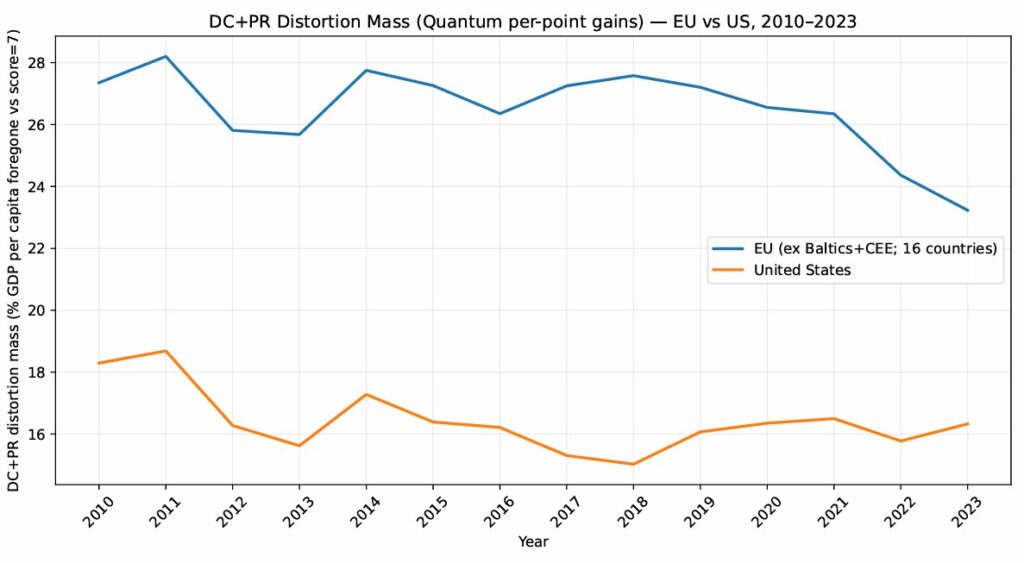
The chart below shows the GDP per capita foregone by Western European countries as a result of their regulatory and property rights barriers. This demonstrates how much more distorted the EU regulatory system is compared to the United States – and therefore why locking into that EU model would be such a bad mistake. The area between the two lines represents the UK’s regulatory headroom compared to U.S. regulations which it would forego with regulatory alignment.*
Singham explains:
“Some argue that it would make sense to align to European regulations because we do a lot of trade with the EU and it would take the friction out of trade. But our models demonstrate how the lack of competition in domestic regulation has a huge economic impact.
“There really is a significant difference between the economic cost of adopting EU regulations as compared to the American model. Having extricated ourselves from the strictures and structures of the European Union, we now have the freedom to chart our own course when it comes to rules and regulations. We can and should have more pro-competitive regulations than any country which is possible under the mutual recognition model which is the norm for non-EU, non-China markets.
“It would be madness now to hand back control of our regulations to Brussels, thereby preventing future gains from adopting pro-competitive regulation and significantly damaging the UK’s external trade policy because much of that trade policy is dependent on a country’s domestic regulatory settings.”
The other incalculable downside of the UK aligning with EU regulations would be its impact on the ability to do trade deals elsewhere in the world.
Singham warns:
“Any alignment to EU SPS regulation would, for example, have a very negative impact on the U.S.-UK relationship. The UK pharmaceutical sector is one of our most productive sectors, but the UK risks that sector by SPS alignment. After the U.S. Supreme Court case on tariffs, it is even more likely that any backsliding on regulation would trigger U.S. concerns as market distortions are now the central plank of the authorities on which the President must rely to deliver his tariff policy.
“It also raises questions about our continued membership of the CPTPP and our trade deals with countries like Australia and New Zealand. It really would be a backward and economically harmful move.”
* Our calculations are based on an application of the ACMD model to Western Europe and the U.S. Clearly the UK could be more pro-competitive than the U.S. in a mutual recognition model and so the total GDP per capita foregone is potentially in play.