The Growth Budget 2026
Ahead of Chancellor John Healey’s first Budget later this month, The Growth Commission today publishes its 2026 Growth Budget with a warning that failure to heed its advice will cost the country dear.
The fourteen members of the independent and non-partisan Growth Commission have endorsed a suite of policies that would transform the UK from a country with stagnant growth that is sliding down the world economic league table into a growing economy that could overtake Japan and Germany to become the world’s fourth largest by the 2040s.
Measures in the package include:
- Abolishing the pensions triple lock and making further savings across the welfare budget
- Reining in public sector pay and pensions and reversing the increase in central government headcount
- Abolishing or phasing out taxes that lose revenue in the long run such as Inheritance Tax, stamp duty on residential property and Corporation Tax on retained earnings
- Wholesale reform of the planning system, including repeal of the Town and Country Planning Act
- Repealing other economically harmful legislation such as the Employment Rights Act and Climate Change Act
- Rejecting any elements of an EU ‘reset’ that would damage the UK’s ability to maintain both an independent trade policy and domestic regulatory autonomy
Growth Commission Chairman Shanker Singham said:
“Ever since its inception, The Growth Commission has set out for successive chancellors the policies needed for sustainable economic growth in the UK.
“We estimate that had our policies been implemented at each of the Budgets since 2023 rather than those that actually were introduced, UK GDP per capita in 2027 would be 7.2% higher – equivalent to an additional £3,185 at today’s incomes and prices for every woman, man and child in the country. If the Chancellor wants to inject this kind of income into the pockets of British people, and give them the hope that has been much discussed at the Labour Party conference, we are confident that he will look seriously at our recommendations.”
The Commission is today putting forward a costed suite of 22 recommendations in its Growth Budget, summarised in the table below:
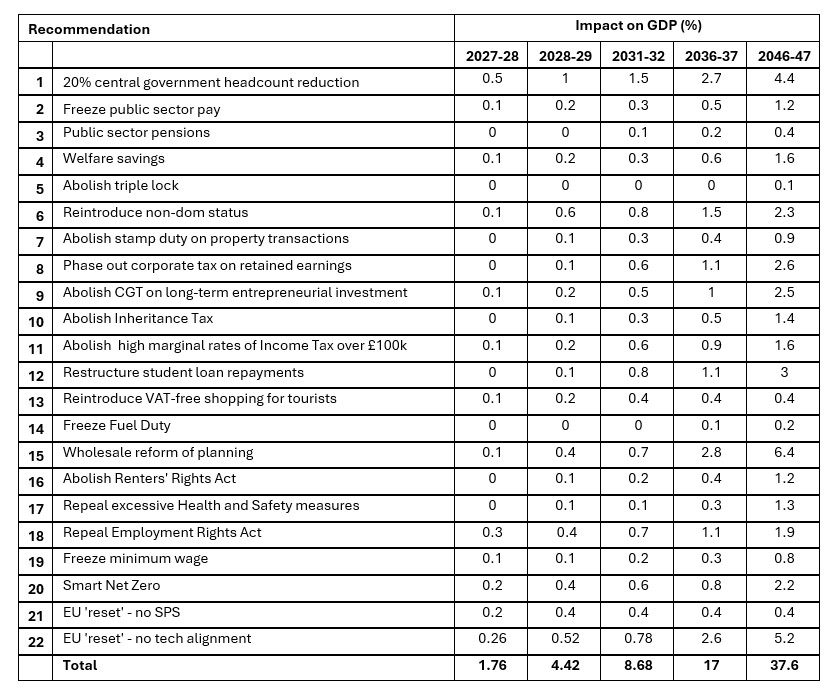
If the measures are implemented, the Commission estimates that there would be huge gains in spending power for households – a 37.6% gain in GDP per capita building up to £16,630 per head by 2046-47.
Moreover, the Commission estimates that the biggest gains proportionately would be for poorer households who would gain from more jobs and moving from welfare into work, higher disposable incomes, lower taxes and much lower costs of living through cheaper rents, housing and food.
Growth Commissioner Douglas McWilliams, principal author of the report and founder of the consultancy Cebr, said:
“We warned this time last year that yet another twelve months of tax and spend would inevitably mean the Chancellor – whoever that was – having to come back for more at the next Budget. And that’s exactly what has come to pass.
“It was the first Chancellor Healey fifty years ago who said that the first thing to do when you are in a hole is to stop digging. So our first recommendation to his namesake today is to junk all plans for filling the fiscal black hole through higher Capital Gains Tax, wealth taxes, exit taxes, bank taxes and extended mansion taxes. Most of these measures would actually reduce revenue eventually – and one of the reasons why the public finances are in such a state is because of similarly badly designed tax increases in past Budgets which have backfired.
“There are also other taxes which we recommend phasing out – the so-called ‘Laffer taxes’, that eventually do more damage than they gain in revenue – including Inheritance Tax, stamp duty on residential property and Corporation Tax on retained earnings.”
Growth Commissioner Ewen Stewart added:
“Equally important is the need to find savings in the sphere of public spending. Serious attention must be paid to the cost of the various elements of the welfare system – including the fabled pensions triple lock – while the government must rein back the unaffordable overrun on headcount, pay and pensions in the public sector.
“These measures, taken together with a raft of supply side reforms, could see the UK transformed and people’s living standards raised, using the gains to cut basic taxes, spend more on defence, build more infrastructure and run down the debt.”
Growth Commission Chairman Shanker Singham concluded:
“One of the most important messages to convey at a time when the Government is toying with a so-called ‘reset’ of UK relations with the European Union, is to ensure that the wider economic cost of any deal with Brussels is considered before irreparable damage is done.
“Any EU ‘reset’ should not add to costs in the food and agricultural sector through aligning British Sanitary and Phytosanitary regulations with those of the EU and should not damage the UK’s ability to maintain both an independent trade policy and domestic regulatory autonomy. The UK should also stay out of the EU tech regulatory area which has done so much damage to the EU’s own tech economy.”
You can read our Growth Budget 2026 in full by clicking here.